How to Match Dates Dynamically in Airtable Automations

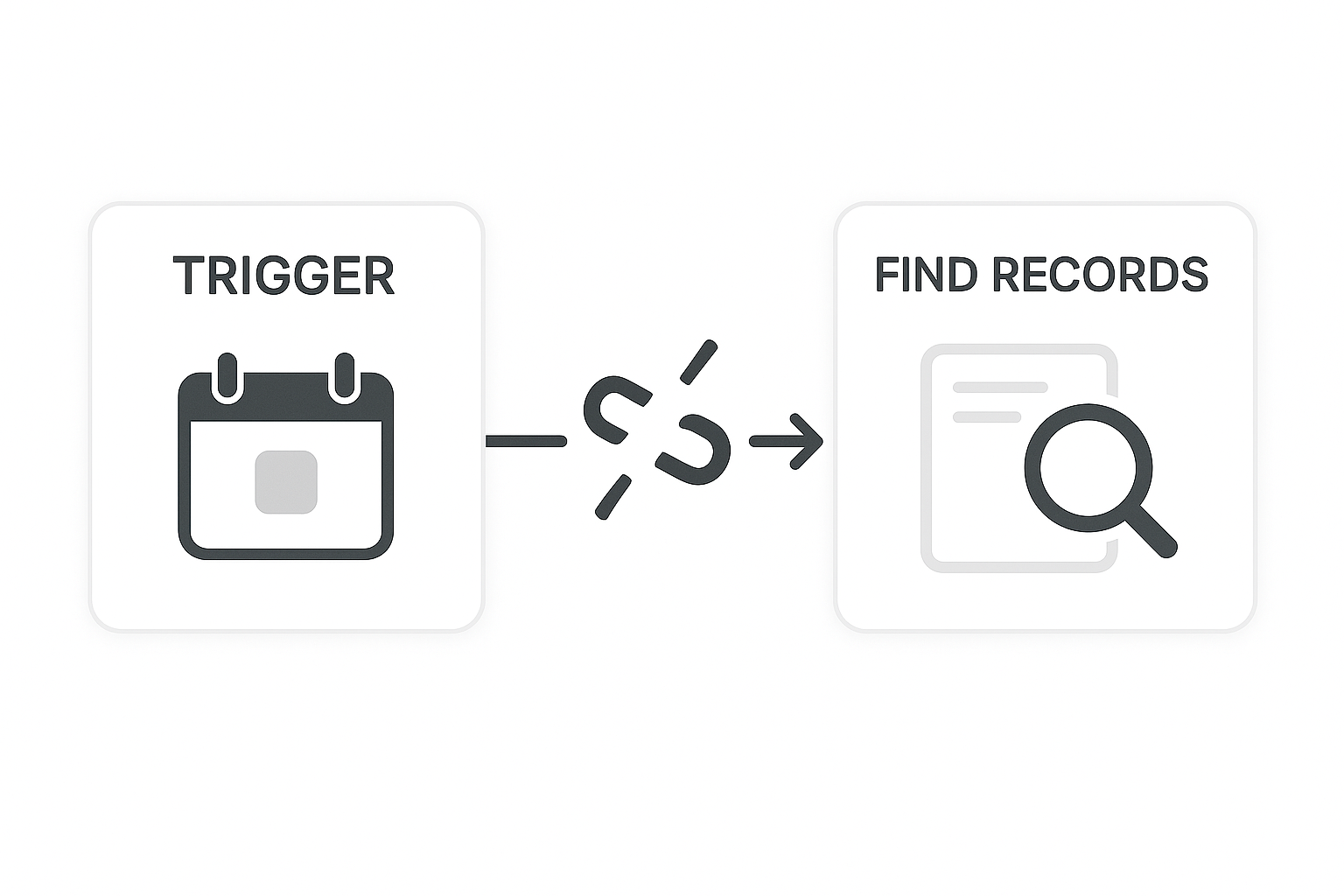
In most database tools, you can filter records where a date field matches a value retrieved in a previous step. In Airtable automations, this does not work directly with date fields.

When you set up a Find records action and try to use a date from a trigger step as the comparison value, Airtable does not offer a way to reference it. You can only compare date fields to fixed values or relative options like "today" or "this week," not to another field value or a token from a prior step.

This is a genuine limitation. Here is the reliable workaround.

Airtable automation workaround using UNIX timestamps to dynamically match dates

Why Date Fields Cannot Be Matched Dynamically

Airtable's Find records action filters records using the field's stored type. Date fields have special handling in Airtable that prevents direct comparison to arbitrary token values from other automation steps.

Number fields do not have this restriction. Any number stored in a field can be compared to any number from a previous step, including one passed as a token.

The workaround converts your date into a number so the Find records action can compare it freely.

The Fix: Convert Dates to UNIX Timestamps

A UNIX timestamp is the number of seconds elapsed since January 1, 1970. Every date converts to a unique number, so two dates that match will always produce the same UNIX timestamp.

Step 1: Add a formula field

In the table you want to search, add a new formula field. Name it something like "Date Timestamp." Use this formula:

VALUE(DATETIME_FORMAT({Date}, 'X'))

Replace {Date} with the name of your actual date field. The 'X' format code in DATETIME_FORMAT outputs the UNIX timestamp. VALUE() converts the string output to a number.

This field now stores the UNIX timestamp of each record's date as a number.

Step 2: Add the same formula to the triggering table

If your trigger record is in a different table (or is the same record that you want to use as the reference), you also need a formula field in that table using the same formula to get the UNIX timestamp of the trigger date.

If the trigger is a form submission or a webhook, you may receive the date as a string. In that case, wrap it in DATETIME_PARSE() first before passing to DATETIME_FORMAT.

Step 3: Update the Find records action

In your automation's Find records action:

  1. Select the field you want to filter on
  2. Choose your new Date Timestamp formula field instead of the original date field
  3. Set the condition to is equal to
  4. In the value box, click the token picker and select the Date Timestamp value from the trigger step

Airtable now compares two numbers, which it handles correctly. Records where the timestamp matches the trigger record's timestamp will be returned.

What to Watch Out For

Timezone sensitivity: UNIX timestamps are calculated in UTC. If your team is in different timezones, two dates that look the same locally may have different UNIX timestamps if one was entered at a time that crosses midnight UTC. For date-only fields (without time), the timestamp is calculated at midnight UTC for that date, so this is less of an issue than with datetime fields.

Date changes do not always retrigger automations: If the date field changes but the triggering condition for your automation is a different field, the Date Timestamp formula field updates automatically when the date changes, but the automation may not refire unless the trigger field also changes. Plan your trigger condition accordingly.

Same date, different times: If your date field stores both date and time (a datetime field), two records with the same calendar date but different times will have different UNIX timestamps and will not match. If you only need to match on calendar date rather than exact datetime, modify the formula to strip the time:

VALUE(DATETIME_FORMAT({Date}, 'YYYYMMDD'))

This produces an 8-digit number (for example, 20260115 for January 15, 2026) that is the same for any time on that calendar date. Two records on the same day will match regardless of the time component.

For more on working with date formulas in Airtable, see why DATETIME_DIFF shows the wrong value and how to fix it for common date formula issues, and how to add recurring events to an Airtable calendar for date-based automation patterns.