How to Move an Airtable Base Under Your Company's Plan
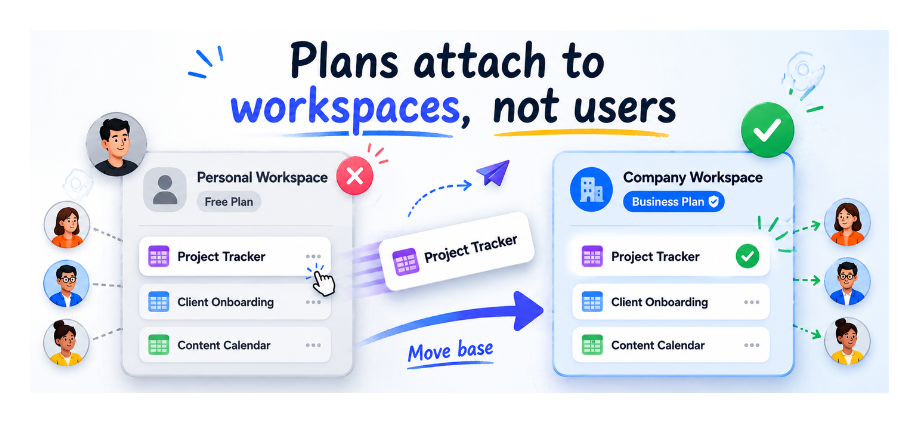
If an Airtable base is showing the wrong plan, look at its workspace first. Airtable applies billing and plan features to workspaces, not to individual user accounts.
There are two ways to put the base under your company's plan:
- Have the company admin upgrade the workspace that already contains the base.
- Move the base into a company workspace that already has the paid plan.
Changing the base owner or signing in with your company email will not move the base onto the company plan.
Start by finding the company workspace
Ask your Airtable admin which workspace is connected to the company plan. You need its name before moving anything.
If the company uses Business or Enterprise Scale, an admin can open the Admin panel and select Workspaces to see the workspaces managed by the company. If the company uses a self-serve Team or Business plan, the plan is managed from the workspace's billing settings.
Once you know where the plan is managed, choose the matching option below.
Option 1: Upgrade the workspace that already has the base
Use this option when the company wants to keep the base, its workspace members, and its other bases together.
For Business or Enterprise Scale, an admin can upgrade the workspace from the admin panel:
- Open the Admin panel.
- Select Workspaces.
- Open Other workspaces.
- Select the workspace that contains the base.
- Click Upgrade workspace.
The base stays where it is, but it now uses the company plan. The existing workspace members do not need to be moved to another workspace.
For a self-serve Team or Business workspace, the workspace Owner can open the workspace billing settings and change the plan there. If you cannot see the billing option, ask the workspace Owner or company admin to do it.
Option 2: Move the base into the company workspace
Use this option when the company already has a paid workspace and does not want to upgrade the workspace where your base currently lives.
Open Airtable home and find the base. Then:
- Click the ... menu next to the base name.
- Select Move base.
- Choose the company's workspace.
- Click Move base to confirm.
The base now uses the plan attached to the destination workspace. Airtable also transfers ownership of the base to the owner of that workspace.
Owners can move bases between workspaces. Creators can move them when the workspace sharing settings allow it. Editors, Commenters, and Read-only collaborators cannot move a base.
Check access before you move it
Moving a base can change access for people who received access through the old workspace.
Someone invited directly to the base keeps that base access after the move. Someone who could open the base only because they belonged to the old workspace loses access unless they are also a member of the company's workspace.
Before moving the base, add those people to the destination workspace or invite them directly to the base. After the move, open the base's Share settings and check the list again.
For a full explanation of collaborator access when a base moves, see what happens to collaborators when you move an Airtable base.
Check your connections afterward
Moving a base keeps its base ID, so existing Airtable syncs can continue working. Still, check the workflows that use the base after the move.
Connections made through one person's account, such as Gmail or Outlook, may need to be connected again by someone in the company workspace. Also check automations, external integrations, forms, interfaces, and shared links.
The base now receives the features and limits of its new workspace. For the detailed moving process, see how to move an Airtable base to another workspace. To understand the difference between a base and a workspace, see Airtable base vs. workspace: which one should you use?.