How to Transfer an Airtable Base to Another Account Without Breaking Anything
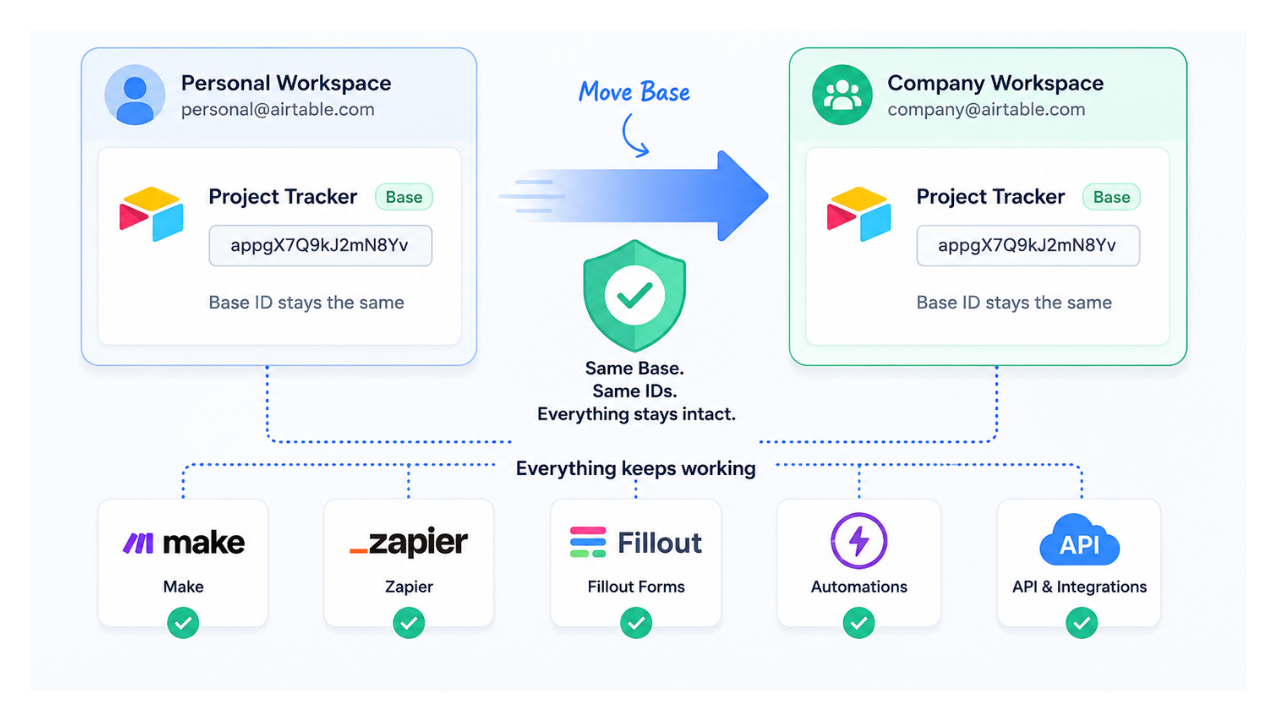
You have built a solid Airtable base in your personal account. It has automations running, forms connected via Fillout or Airtable's native forms, and possibly external integrations through Make or Zapier. Now the company wants to bring this base into their official Airtable account.
The question is whether moving the base will break everything that depends on it.
The short answer: no. Moving a base between workspaces, even across different Airtable accounts, preserves all internal IDs. Everything that was working before the move continues working after.
What Happens When You Move a Base
When you move a base from one workspace to another, Airtable transfers ownership without rebuilding anything. The base's internal identifiers stay exactly the same:
- The Base ID (the
app...identifier in the URL) does not change - All table IDs, field IDs, and view IDs remain intact
- Record IDs for existing records are preserved
- Automations remain configured and continue running
- Native Airtable form links keep working
- External integrations (Make, Zapier, n8n, Fillout, API calls) continue working because they reference the same base ID
From Airtable's perspective, and from the perspective of every tool connected to your base, it is the same base in a different location.
How to Move the Base
- Open the workspace that currently contains the base
- Click the ... (three dots) menu next to the base name
- Select Move base
- In the dialog, click the dropdown and select the destination workspace (the company account must have given you access to their workspace first)
- Confirm the move
The move is immediate. This is the same process whether you are moving within the same Airtable account or to a different account entirely, as long as you have been added to the destination workspace. For the simpler case of moving a base between workspaces in the same account, the steps are identical. The base disappears from the old workspace and appears in the new one.
What to Check After the Move
Even though everything technically carries over, a few things are worth verifying once the base is in its new home:
Automation connections: Open the Automations tab and check any automations that connect to external services. Some service connections (Gmail, Outlook, Slack) are tied to the user account that set them up. If that user is not in the new workspace, those connections may need to be re-authenticated. Check each automation's action steps and look for any that show a warning icon.
Collaborator access: Collaborators who were invited at the base level in the old workspace do not automatically carry over to the new workspace. They need to be re-invited. Workspace-level collaborators from the old workspace also do not transfer only the base itself moves.
Plan features: If the new workspace is on a lower plan than the old one, some features may no longer be available. For example, if the old workspace was on Business and the new workspace is on Team, field-level permissions configured on the base will stop working. Review the base's features against the new workspace's plan before moving. Understanding how plans attach to workspaces helps here, since a base picks up the plan of whatever workspace it lands in.
Third-party integrations: Make, Zapier, and n8n scenarios that reference your base continue working because the base ID is unchanged. However, if those integrations authenticated using credentials tied to the old workspace owner, you may need to re-authenticate the Airtable connection inside Make or Zapier using credentials from the new workspace owner.
What If You Need to Keep a Copy in Both Workspaces
Moving the base removes it from the original workspace entirely. If you need the base to remain accessible in both places, you have two options:
- Duplicate the base into the new workspace before moving. The duplicate gets a new base ID and does not inherit automations or external connections you would need to rebuild those.
- Use Airtable Sync to mirror specific tables from the original base into a base in the new workspace. This keeps the original in place while giving the new workspace access to the data.
For more on working with bases across workspaces and accounts, see How to Move an Airtable Base to Another Workspace for the standard move scenario, and Airtable Base vs Workspace: What's the Difference for how the billing and access model changes once the base is in the new workspace.