How to Monitor Your Airtable Automations (And Know When They Fail)
When several Airtable automations run in the background, it helps to see which ones are running and find out quickly when one fails.
Airtable gives you the details for each automation in Run History. If you want a wider view, you can also create a calendar that records successful runs. I’ll start with that calendar, then show you how to investigate and fix a failed run.
Create a calendar of successful runs
Airtable keeps each automation's history separate. To see several automations on one calendar, create an Automation Logs table in the base.
Add these fields:
| Field | Type | Purpose |
|---|---|---|
| Automation Name | Single line text | The automation that finished |
| Ran At | Date with time | When the run finished |
| Status | Single select | The result, such as Success |
| Notes | Long text | Optional details from the run |
| Records Affected | Number | Optional count of processed records |
At the end of each automation, add a Create record action. Choose Automation Logs as the table, enter the automation name, and set Ran At to the Actual run time token. Set Status to Success, then add any notes or record counts you want to keep.
Because this action is last, Airtable creates the log record only when the earlier steps finish successfully. This table shows successful runs. Use Airtable's native history and failure emails when you need to investigate a failed run.
Create a Calendar view in Automation Logs and use Ran At as the date field. Group or colour the records by Automation Name to see which automations ran and when. A Timeline view works too if you prefer to see each automation on its own row.
Check what happened in a run
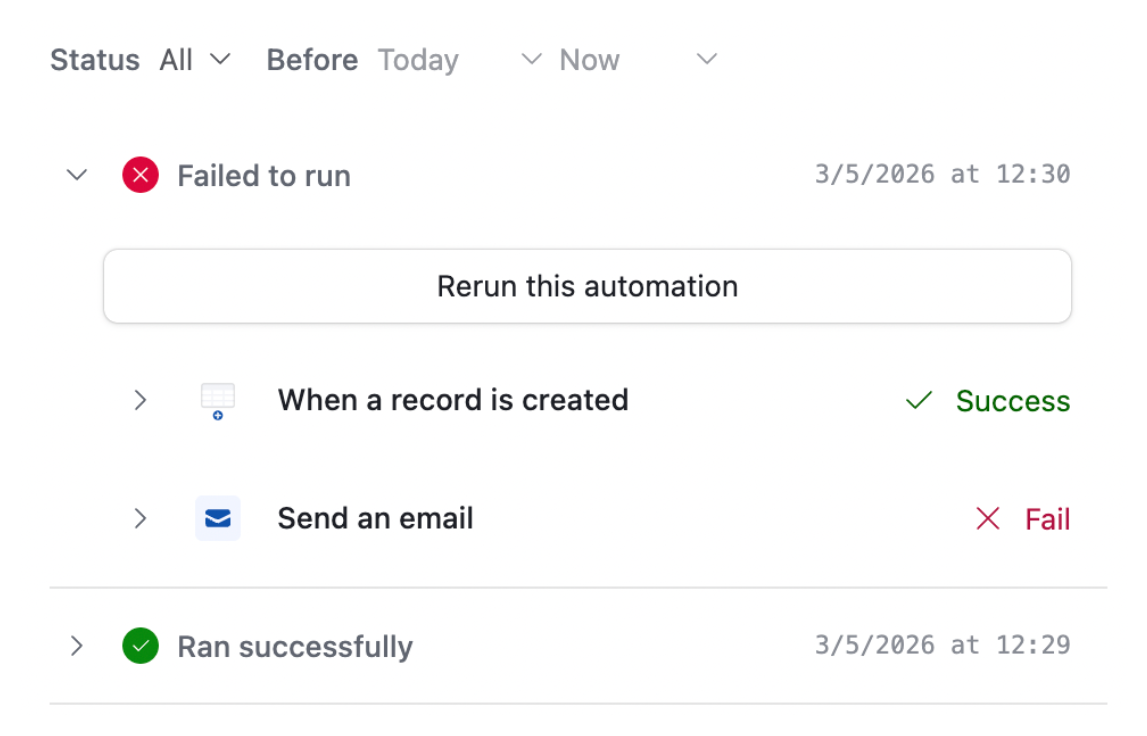
When the calendar shows that something did not run as expected, open the base, click Automations, and select the automation you want to inspect. Click Automation history, then open Run History.
Filter the list by All, Succeeded, Failed, or Cancelled. Open a run and expand its steps to see the values Airtable passed between them and the error from the step that failed.
If the automation stopped working after a change, open the Version history tab. It shows earlier versions of the automation and who changed them.
Get an email when an automation fails
Run History is useful when you are already checking Airtable. You can also have Airtable notify you as soon as an automation fails.
Airtable sends the failure email to the person who last turned the automation on. To notify other people, open the automation, click the dropdown next to its name, and select Manage subscribers.
Add the collaborators or service accounts that should receive the alerts. You can add up to 10 subscribers, and they need Creator permissions or higher on the base.
Fix and rerun a failed automation
Open the failed run and click Rerun when the problem was temporary. If the failure came from missing data, fix the record and trigger a new run for that record.
If you changed the automation itself, start a new run as well. Rerun uses the configuration from the original attempt, so it does not test the updated version.
If the workspace is close to its automation limit, open your Airtable account overview, select the workspace, and open its Workspace summary. For ways to reduce unnecessary runs, see how to limit Airtable automation runs.
For more on the number of automations you can create in a base, see Airtable automation limits and how to free up space.