How to Show a Record ID After an Airtable Form Submission
When someone submits an Airtable form, you may want to show them a reference number right away.
For example:
- support ticket number
- application ID
- order request number
- internal record ID
Airtable's built-in confirmation message cannot show dynamic values from the record that was just created.
So you cannot put something like this directly on Airtable's default thank-you screen:
Your reference number is 1042
But you still have three practical options.
Option 1: Send the Reference Number by Email
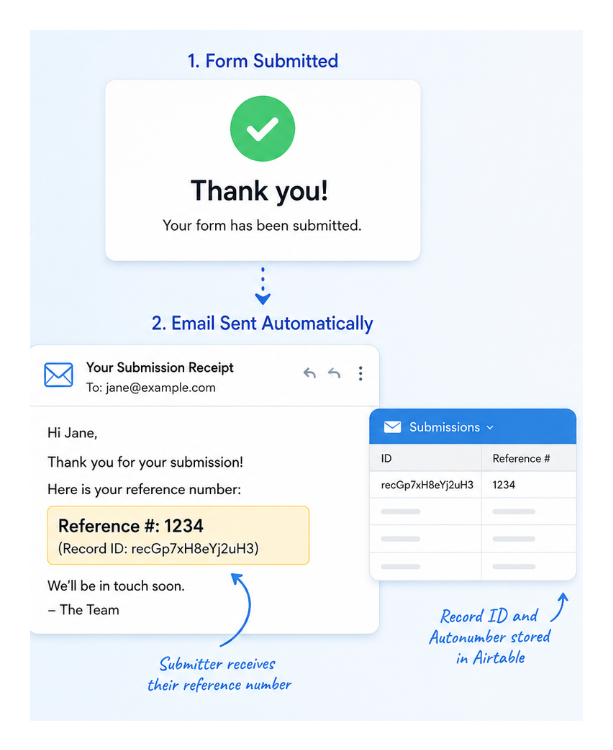
The most reliable approach is an automation that triggers immediately after the form is submitted and emails the submitter their reference number.
How to Set It Up
- Create a new automation in your Airtable base
- Choose the trigger When a form is submitted
- Select the form you want to use
- Add a Send email action
- Set the recipient to the email address field from the form
- Insert either the Record ID field or an Autonumber field into the email body using the token picker
After the form is submitted, the user sees the normal confirmation screen and then receives an email containing their reference number.
This workflow requires the form to collect the submitter's email address. If your form does not currently include an email field, add one and make it required.
For a more advanced confirmation email with dynamic links and additional submission data, see how to send a confirmation email after an Airtable form submission.
Record ID vs Autonumber
You can send either the Airtable record ID or a separate autonumber field.
The Airtable record ID looks something like this:
recXXXXXXXXXXXXXX
It works fine as a unique identifier, but it is not especially readable or user-friendly.
In most cases, an Autonumber field creates a better experience. Each new record automatically receives the next number in sequence.
That number is easier for users to reference later in support requests, emails, or phone calls.
Autonumber values can have gaps if records are deleted. That is fine for most reference numbers, because the goal is a unique number, not a perfect count.
The automation setup is exactly the same either way.
Option 2: Redirect With the New Record ID
Airtable forms can also redirect users to a custom URL after submission.
On paid plans, Airtable lets you include the new record ID in that redirect URL using {record_id}.
For example:
https://yourwebsite.com/thank-you?recordId={record_id}
After submission, Airtable replaces {record_id} with the ID of the record that was just created.
Set it up like this:
- Open your form settings
- Turn on Redirect to URL
- Enter your thank-you page URL
- Add
{record_id}where you want the new record ID to appear in the URL
Your page can then show the record ID from the URL.
This is useful when the Airtable record ID is enough.
If you want the page to show an autonumber, calculated field, or other record values, the page needs to fetch that record from Airtable through the API or another backend workflow.
Keep the custom page limited to information the submitter is allowed to see. A record ID in the URL should not unlock private record details by itself.
Option 3: Use Fillout
Fillout supports dynamic confirmation pages that can display values from the newly created Airtable record immediately after submission.
For example, you can show:
- an autonumber reference
- a ticket number
- calculated fields
- other submitted values
directly on the success screen.
This removes the need for a separate confirmation email just to communicate the reference number.
Fillout connects directly to your Airtable base, and the confirmation page is configured inside Fillout's form builder.
If you want to stay entirely inside Airtable, use the email automation or the redirect URL with {record_id}.
If the user must see a friendly ticket number or calculated value on-screen immediately, Fillout is usually the cleaner option.