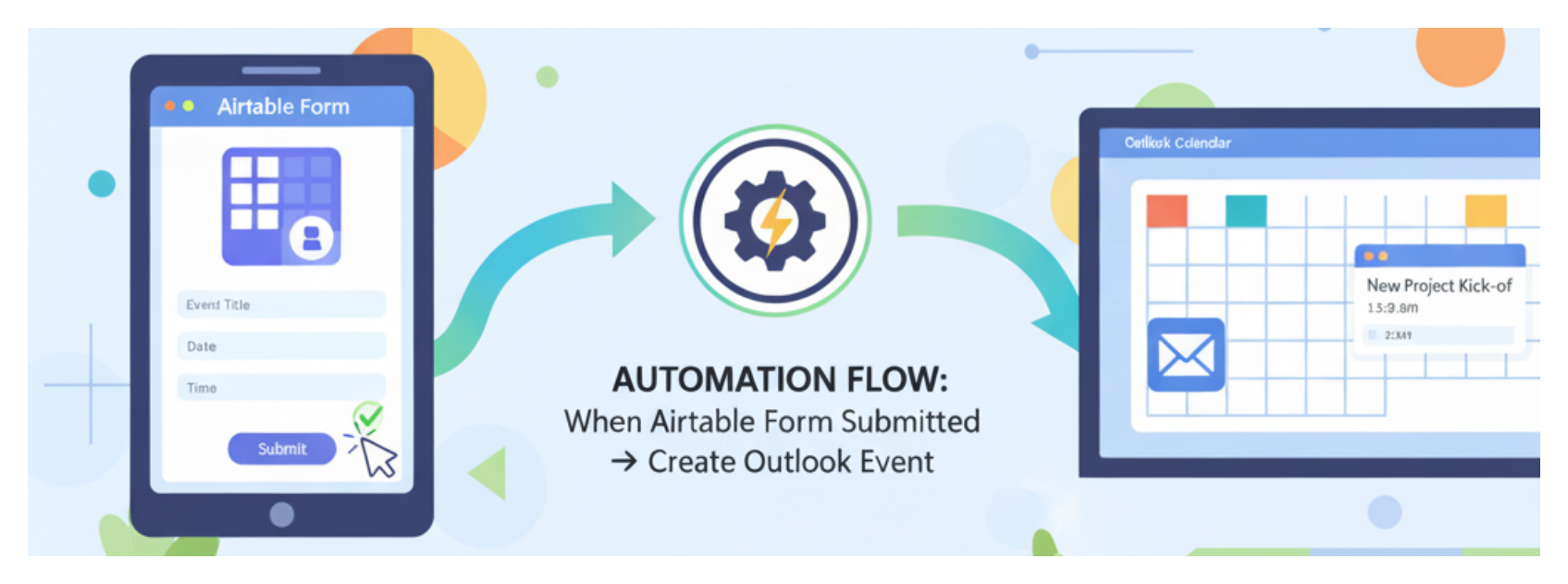
How to Automatically Send Outlook Calendar Invites From Airtable
Your department regularly hosts workshops and events, and you use an Airtable form to collect registrations. Every submission is saved as a record in your base. The next step is getting each registrant a proper Outlook calendar invite without anyone doing it by hand.
There are two ways to do this: Airtable's native Outlook Calendar automation action, or Make. Which one fits depends on how much control you need over the setup.

Option 1: Airtable's Native Outlook Calendar Action
Airtable has a built in Outlook Calendar: Create event automation action, so for most registration or booking workflows you don't need a separate tool at all.
Here is how to set it up:
- Open your Airtable base and click on Automations.
- Create a new automation that triggers when a new registration record is created.
- For the action, select Outlook Calendar: Create event.
- Connect your Outlook account and choose which calendar to use.
- Map your Airtable fields to the event details, such as Title, Description, Start Time, End Time, and the participant's Email as an attendee.
- Test the step, then turn the automation on.
Once it runs, Airtable creates the event on the connected Outlook calendar and sends an invite to any attendees you mapped.
The main tradeoff is that the action runs through a single connected Outlook account, so every event lands on that one calendar, and the person you're inviting has to be added explicitly as an attendee rather than being the event owner. For a department running one shared calendar, this is usually exactly what you want. If having every event pile onto one person's calendar is a problem, or you need something the native action doesn't support, that's when Make is worth the extra setup.
Option 2: Make, for More Control
Make is worth reaching for when you need something beyond what the native action offers: creating events across multiple calendars or accounts instead of one, recurring event series, or branching logic based on other fields on the record before the event gets created.
Step 1: Set the Airtable trigger
In Make, add an Airtable: Watch Records module. Connect it to your Airtable base and select the table and view to monitor. Set it to trigger on new records or records that match a specific filter (for example, records where Status equals "Confirmed").
Step 2: Add the Microsoft 365 Calendar module
Add a Microsoft 365 Calendar: Create an Event module. Connect it to your Outlook account (Make will prompt for OAuth authorisation the first time).
Map the fields from the Airtable trigger to the calendar event fields:
- Subject: map to the Airtable field that holds the event name or meeting title
- Start date/time: map to the Airtable date field, formatted correctly (Make handles the conversion if the field is a proper Airtable datetime)
- End date/time: map to a duration or end time field, or add a fixed duration (for example, always 1 hour after the start)
- Location: map to a location field if you have one, or leave blank
- Body: map to a notes or description field for any event details
- Attendees: map to an email field or multiple email fields if you want Outlook to send the invite to attendees automatically
When attendees are added, Outlook sends each person a calendar invite email with accept, decline, and tentative options, exactly as if you had created the event manually in Outlook.
Step 3: Write the event ID back to Airtable
Add an Airtable: Update a Record module after the calendar creation step. Map the event ID returned by the Microsoft 365 module into a field on the Airtable record. The event ID is what matters here, not the event URL. It's the value you'll need if you ever want to update or delete this specific event later, while the URL is only useful as a link for a person to click.
Storing the event ID also lets you prevent duplicate events. Before the Create an Event module runs, add a filter or a Search Records step that checks whether this Airtable record already has an event ID saved. If it does, skip straight to updating that event instead of creating a second one alongside it.
Handling Recurring Events
Make's Microsoft 365 Calendar module has support for recurring event patterns, though the exact options depend on which version of the module you're using, so check the field list in your own scenario rather than assuming every recurrence pattern is available. If you want to create a series of events from a single Airtable record (weekly check-ins for the duration of a project, for example), configure the recurrence settings in the calendar module using the recurrence fields Make exposes there.
For the Airtable side, how to add recurring events to an Airtable calendar covers the data structure for representing recurring schedules, which feeds naturally into this Make workflow.
Google Calendar Instead of Outlook
If your team uses Google Calendar rather than Outlook, the same two options apply, and Airtable's native action covers it just as directly as it does for Outlook.
For the simple case, Airtable has a built in Google Calendar: Create event automation action, set up the same way as Option 1 above: connect your Google account, choose a calendar, and map your fields to the event details. No Make required.
If you need the same things that pushed you toward Make for Outlook, such as updating events later, multiple calendars, or recurring series, the Make workflow applies with one module change: replace the Microsoft 365 Calendar module with the Google Calendar: Create an Event module. Everything else (Airtable trigger, field mapping, writing the event ID back) works identically.
Keeping Events Updated
If you're using the native Airtable action, updating an event later isn't automatic just because you created it, but it is supported. Airtable also has an Outlook Calendar: Update event action, which needs the event's Event ID to know which event to change.
To use it, add an Update record step right after Create event that writes the returned Event ID into a field on the Airtable record, the same idea as the Make setup described above. Then build a second automation, triggered when the relevant fields change on that record, that runs Outlook Calendar: Update event using the stored Event ID. Without that stored ID, there's nothing for the update action to reference, so it's worth setting up from the start even if you don't need it right away.
If you're on the Make scenario and have already stored the event ID as described above, the same idea applies. Create a second Make scenario triggered by Airtable: Watch Records filtered to records where the event details have been modified. Use the Microsoft 365 Calendar: Update an Event module with the stored event ID to update the existing calendar event rather than creating a duplicate.